Meta, Google & Klaviyo: How Your Advertising Ecosystem Actually Works
If you’re running paid advertising for your DTC brand, chances are you’re checking your Meta dashboard, your Google dashboard, and your Klaviyo dashboard, and trying to make sense of three very different stories. Each platform tells you it’s working. Each one claims credit for your sales. And none of them are giving you the full picture.
The problem isn’t that your advertising isn’t working. The problem is that you’re looking at each platform in isolation, when in reality they’re all part of a single, connected ecosystem. Understanding how they work together and where each one fits in the customer journey is the difference between making confident budget decisions and flying blind.
Here’s how to think about it.
The three platforms and what they actually do
Meta: the discovery and reminder platform
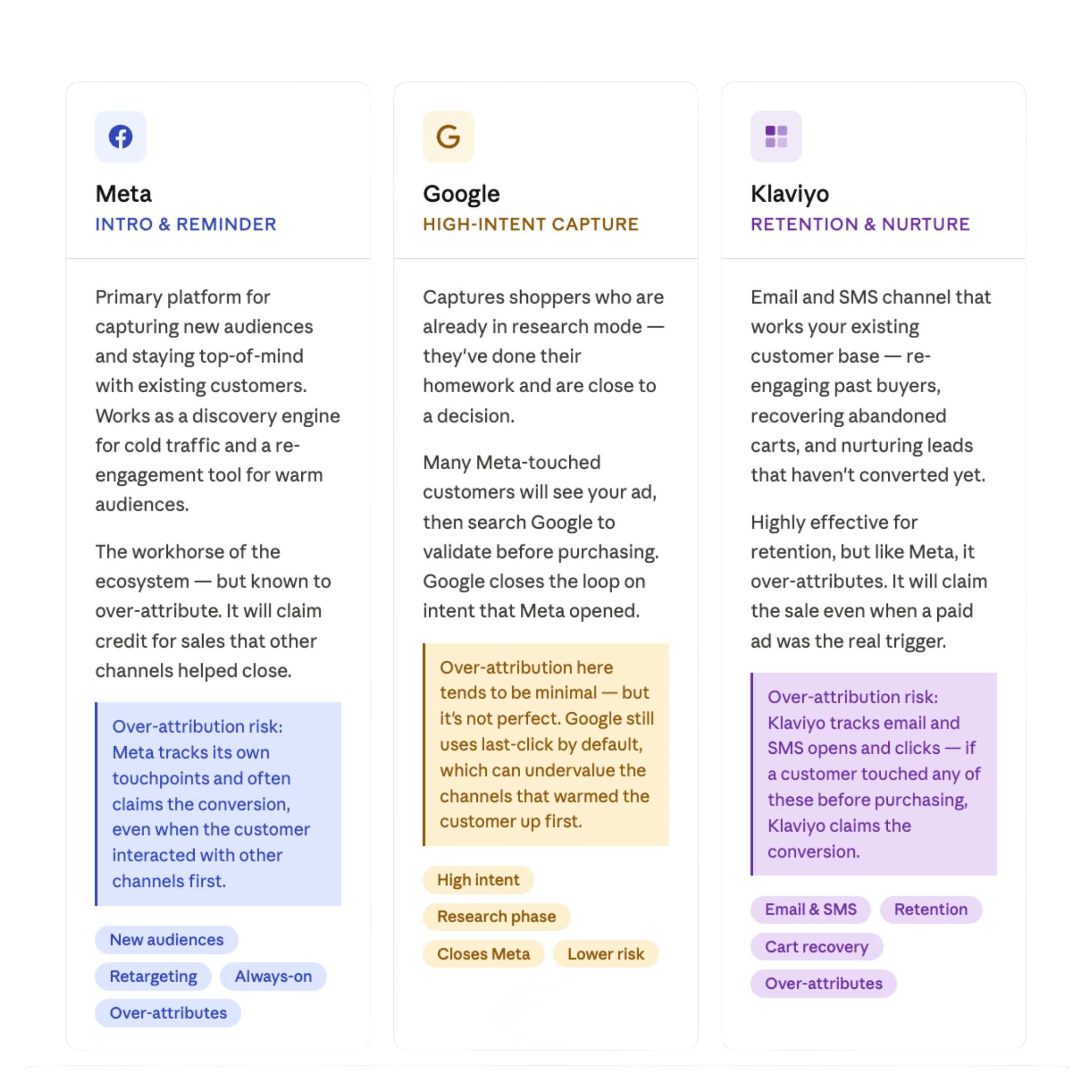
Meta (Facebook and Instagram) is where most DTC brands do the heavy lifting. It’s your primary tool for two things: capturing new audiences who haven't heard of you, and staying top-of-mind with those who already have.
For cold audiences, Meta acts as a discovery engine. Someone is scrolling Instagram, your ad stops them, and for the first time, they become aware your brand exists. For warm audiences, people who’ve visited your site, engaged with your content, or bought from you before - Meta keeps you in their peripheral vision until they’re ready to buy again.
Meta is the workhorse of the ecosystem. But it comes with an important caveat: it is well known for over-attributing. More on that shortly.
Google: the high-intent capture platform
Google plays a fundamentally different role. By the time someone is searching on Google, they’re not discovering - they are researching. They’ve already decided they want something. They’re now deciding where to buy it.
This is why Google and Meta work so well together. A customer might see your Meta ad, click through, browse your site, and leave without buying. A few days later, they search Google to do a bit more research before committing. Your Google ad shows up. This time, they buy.
Google closes the loop on the intent that Meta opened. It captures the customers who need a little more time and a little more conviction before purchasing. Over-attribution here tends to be lower than Meta's, but it’s not perfect either. Google still defaults to last-click attribution in many setups, which can undervalue the channels that warmed the customer up in the first place.
Klaviyo: the retention and nurture platform
Klaviyo is your email and SMS channel. Unlike Meta and Google, which are focused on acquiring customers, Klaviyo’s job is to work with the customers you already have - re-engaging past buyers, recovering abandoned carts, and nurturing leads who haven’t converted yet.
It’s highly effective at retention. But like Meta, Klaviyo is known to over-attribute. If a customer opened an email at any point in their journey before purchasing, Klaviyo will claim that sale… even if a Meta or Google ad was the real trigger that brought them back.
The attribution problem: why your numbers don’t add up
Here’s the uncomfortable truth: if you add up what Meta, Google, and Klaviyo each claim in attributed revenue, the total will almost certainly be significantly higher than what actually landed in your bank account. Sometimes double. Sometimes more.
This happens because every platform tracks its own touchpoints and claims the win.
A single customer journey might look like this:
→ They see your Instagram ad while scrolling (Meta touchpoint)
→ They click through, browse, and leave without buying
→ They receive your abandoned cart email (Klaviyo touchpoint)
→ They search your brand name on Google and click your ad (Google touchpoint)
→→ They purchase
One sale. Three platforms claiming credit. This is over-attribution, and it’s one of the most common reasons advertising data feels misleading and decisions feel impossible.
A simple way to think about it
Think of it like a word-of-mouth referral.
A friend tells you about a brand. You visit the website, have a look around, and leave. A few days later, you see their Instagram ad, and this time you buy.
Your friend deserves some credit for that sale. So does the Instagram ad. But only one sale happened, and both parties want recognition for it.
That’s exactly what Meta, Google, and Klaviyo are each doing behind the scenes. They all played a role. They all want credit. And there’s no single platform that will tell you the full, unbiased truth about which one actually drove the purchase — because each one has an incentive to make their own numbers look good.
How to actually measure what’s working
The answer isn’t to find one magic attribution tool and trust it completely. No third-party tool is perfect either because they all rely on probabilistic modelling and pixel-based tracking, which is increasingly limited by iOS privacy changes and browser restrictions. More on this shortly…
The answer is to look at the whole ecosystem together, and to anchor everything to a number that no platform can inflate: your MER.
What is MER?
MER stands for Marketing Efficiency Ratio. It’s calculated like this:
Total Revenue ÷ Total Ad Spend = MER
Both numbers come from sources that can’t be manipulated. Your total ad spend is the amount that's actually left in your account across all platforms. Your total revenue is the amount that actually came into your store. No platform is involved in calculating either number.
If your MER is 5, it means that for every $1 you spend on advertising, you get $5 in revenue. It won’t tell you exactly which platform drove which sale. But it tells you whether the machine is working as a whole, and that’s the most important thing to know.
One caveat worth knowing: MER captures all revenue, including organic. If you had a big PR moment, a viral post, or an unusually strong sale that month, that revenue is included and can make your MER look stronger than it would with paid advertising alone. It’s still the most reliable number you have, just worth contextualizing when something unusual happened in the business.
Using third-party attribution alongside MER
Third-party attribution tools, like Ad Beacon, Triple Whale, or Northbeam, give you a view across your entire ecosystem rather than relying on any single platform’s self-reporting. They help you identify whether you’re over-investing in one channel, or whether a platform is taking more credit than it’s earned.
They’re not a perfect solution. But used alongside your MER, they give you a much clearer picture than staring at three separate dashboards and trying to reconcile conflicting numbers.
Think of it this way: third-party attribution tells you where the signals are. MER tells you if the overall business is healthy. You need both.
The bottom line
Meta, Google, and Klaviyo are each doing something important in your advertising ecosystem. Meta opens the door. Google captures the customer when they’re ready. Klaviyo brings them back and keeps them loyal.
But none of them will give you the full, honest picture on their own. Every platform has an incentive to look good. Every dashboard is telling its own version of the story.
The brands that scale with confidence aren’t the ones that trust one platform’s numbers. They’re the ones who understand the ecosystem, track their MER, and make decisions based on what the whole business is doing → not just what any single dashboard is claiming.
Want to understand how your advertising ecosystem is performing? Book A Free 20 Minute Chat With Us.